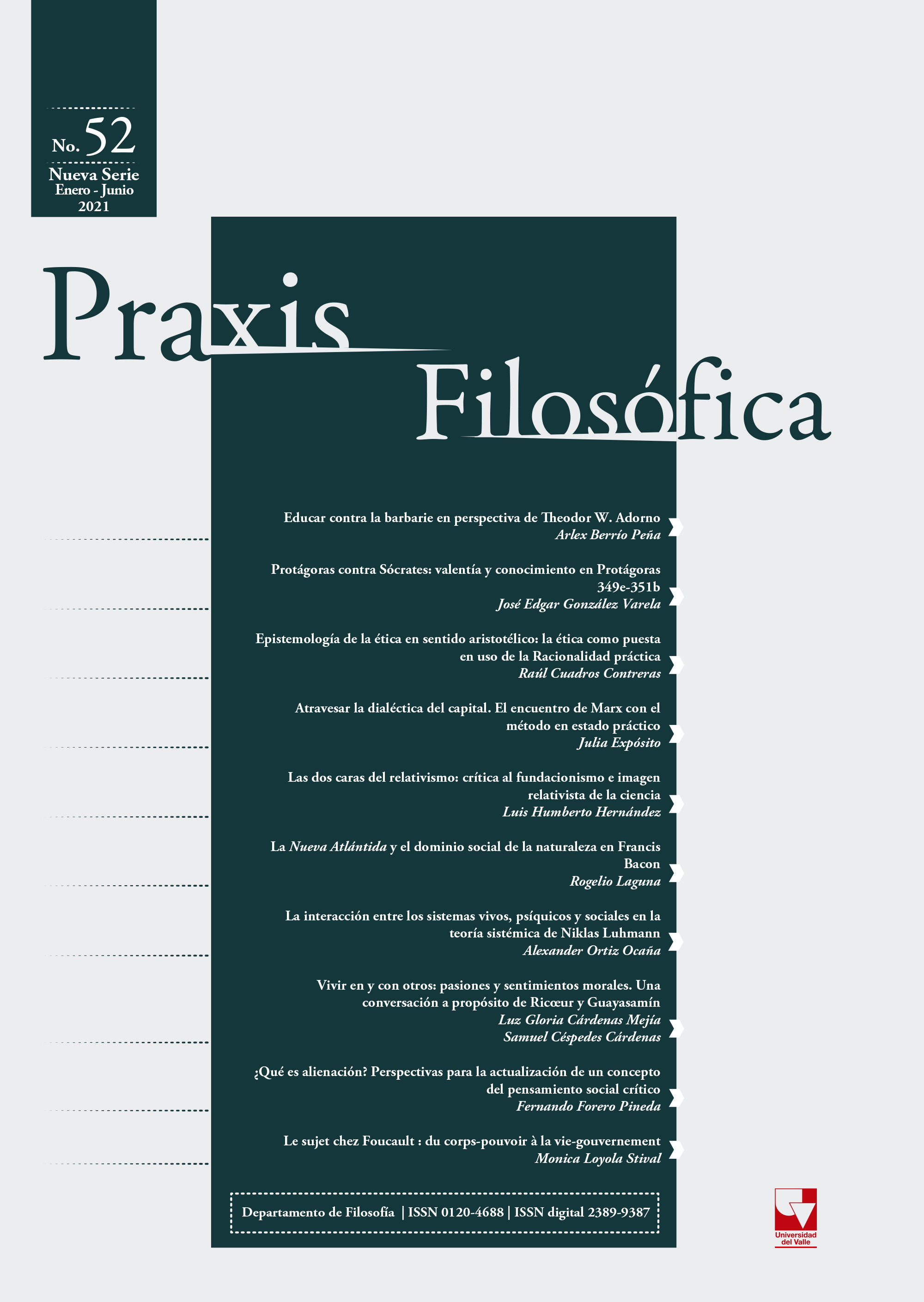
Protagoras Against Socrates: Courage and Knowledge in Protagoras 349e-351b

Article Sidebar
Main Article Content
Towards the end of Plato’s Protagoras, Socrates and Protagoras argue about whether courage and knowledge (or wisdom) are the same. The first argument that Socrates employs to show this, and Protagoras’ response, have been subject to much discussion and disagreement among scholars (349e1-351b2). I think that no available interpretation of this debate is fully satisfactory, for they tend to favor exclusively either Socrates or Protagoras. In this paper I offer a new, more balanced and complete, interpretation, according to which, both Socrates’ argument and Protagoras’ response are reasonable and valid in the context of the dialogue, and both achieve, to some extent, their own goal.
- Pluralism
- Wisdom
- Virtue
- Courage
- Knowledge
Adam, A. M., & J. Adam (1893). Platonis Protagoras. Cambridge University Press.
Bluck R. S. (1949). Plato's Life and Thought. Routledge.
Burnet, J. (1903). Platonis Opera [Tomus III]. Clarendon Press.
Cobb, W. S. (1982). The Argument of the Protagoras. Dialogue, 21(4), 713-731. https://doi.org/10.1017/S0012217300023866
Cuadros Contreras, R. (2013). Sofística, retórica y filosofía. Praxis Filosófica, (37), 75-93. https://doi.org/10.25100/pfilosofica.v0i37.3454
Devereux, D. T. (1975). Protagoras on Courage and Knowledge: Protagoras 351a–b. Apeiron, 9(2), 37–9.
Divenosa, M. (2006). Platón: Protágoras. Losada.
Festugière, A. J. (1946). Sur un passage difficile du «Protagoras». Bulletin de correspondance hellénique, 70, 179-186.
Grube, G. M. A. (1933). The Structural Unity of the Protagoras. Classical Quarterly, 27(3-4), 203-7. https://doi.org/10.1017/S0009838800016979
O’Brien, M. (1961). The “Fallacy” in Protagoras 349D–350C. Transactions and Proceedings of the American Philological Association, 92, 408–417. https://doi.org/10.2307/283826
Sauppe, H. (1884). Platon: Ausgewählte Dialoge, [Bd. 2]. Weidmann.
Schanz, M. (1881). Platonis Opera Quae Feruntur Omnia, [Bd. 7]. Tauchnitz.
Taylor, A. E. (1927). Plato: The Man and His Work. Methuen.
Taylor, C. C. W. (1991). Plato: Protagoras. Clarendon Press (2a. ed.).
Vlastos, G. (1956). Introduction. En B. Jowett. (Trad.), Plato: Protagoras, (pp. vii–viii). The Liberal Art Press.
Weingartner, R. H. (1973). The Unity of the Platonic Dialogue. Bobbs-Merrill.
Weiss, R. (1985). Courage, Confidence, and Wisdom in the Protagoras. Ancient Philosophy, 5(1), 11-24. https://doi.org/10.5840/ancientphil19855123
Wolfsdorf, D. (2006). Courage and Knowledge at Protagoras 349e1–351b2. Classical Quarterly, 56(2), 436-444. https://doi.org/10.1017/S0009838806000449
Downloads




Accepted 2020-09-28
Published 2021-04-15

This work is licensed under a Creative Commons Attribution-NonCommercial-ShareAlike 4.0 International License.
De acuerdo con nuestra política (Licencia Creative Commons CC BY-NC-SA 4.0) los artículos presentados y sometidos al proceso editorial en la revista Praxis Filosófica no tienen costo alguno para sus autores ni retribuciones económicas para la revista. El artículo de carácter inédito, producto de investigación o de algún proyecto que se presente a Praxis Filosófica, no podrá estar sometido a otro proceso de publicación durante el proceso que se lleve en nuestra revista.