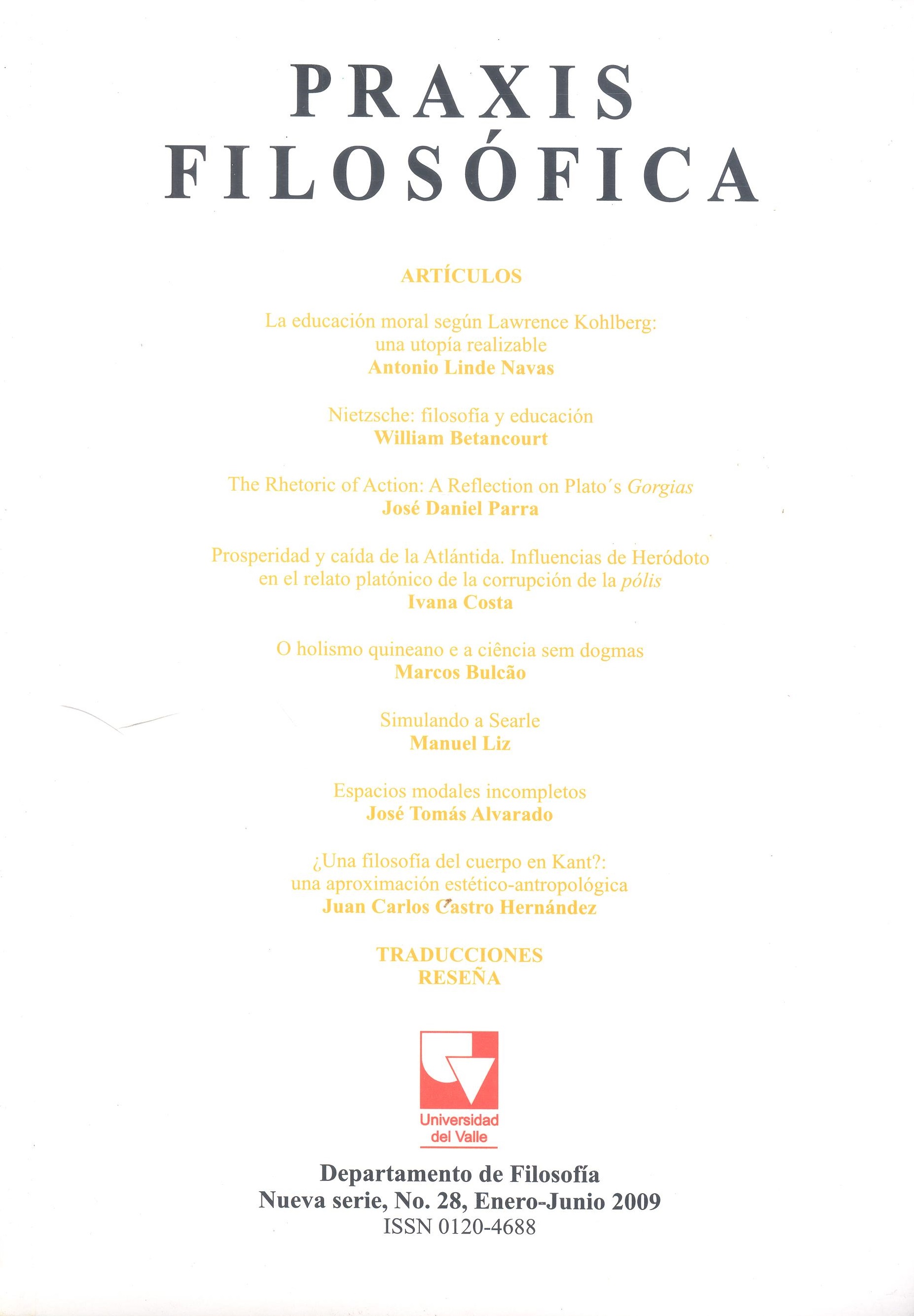
The prosperity and the fall of Atlantis. Herodotean Influences in the platonic tale of the corruption of the pólis

Article Sidebar
Main Article Content
Departing from an analysis of the way in which Herodotus reflects on prosperityand fall in his Croesus lógos, this article seeks to show some linksbetween this story and Plato’s tale of the rise and fall of Atlantis, a brilliantfable about the corruption and decay of the political community. I will try toshow up to what extent the cause of the fall of the powerful and desappearedisland lays in its inhabitants gradual disregard of phrónesis. I will try tocontribute in this way –secondarily—to reinforce, with new hypothesis, acertain interpretation about the role played by the Atlantis myth in the unityand coherence of the whole Platonic project of Timaeus-Critias dialogues.In these pages, I will first analyze (section 2) the crucial difference betweenHerodotus conception of prosperity and the one shown by archaic poets.Second, (section 3), I will analyze the more superficial and the more deepinfluences of Herodotus conception in the Platonic making of his Atlantismyth. I will try to show the strategic presence, both in Timaeus and Critias,of the references to phrónesis. Then, I will try (section 4) to confirm theinfluence of Herodotus in Plato, looking at the narrative construction of thecharacteres of Solon and above all of Croesus. Finally (section 5) I will offersome hypothesis about the reasons Plato might have had to finish his owntale sinking not only the decadent Atlantis, but also the victorious Athens.
- Plato
- corruption of the polis.
- Herodotus
- Croesus
- Atlantis
- Corruption of the polis
Calvo, T. y Brisson, L. (eds.) (1997): Interpreting the Timaeus – Critias, Proceedings of the IV Symposium Platonicum, Sankt Augustin, 1997.
Costa, I. (2007): “Creso y Solón en el espejo de la Atlántida”, Synthesis vol. 14,Fac. de Humanidades, UNLP, pp. 71-90.
Donini, P. (1988): “Il Timeo, unità del dialogo, verosimiglianza del discorso”, en Elenchos (fasc. 2) 1988, pp. 5-52.
Erler, M. (1998): “Idealitá e storia. La cornice dialogica del Timeo e del Crizia e la Poetica de Aristotele”, en Elenchos (fasc. 1), 1988, pp. 5-28.
Gaiser, K. (1968): Platons ungeschriebene Lehre, Tubinga, 1968.
Gill, Ch. (1977): “The genre of the Atlantis Story”, Classical Philology vol. 72 Nº4 1977, pp. 287-304.
Gill, Ch. (1979): “Plato’s Atlantis story and the birth of fiction”, Philosophyand Literature 3, 1979, pp. 64-78.
Griffiths. J.G. (1985): “Atlantis and Egypt”, Historia, vol. 34, pp. 3-28.
González de Tobia, A.M. (2004): “El pensamiento moral de Baquílides, entre ólbosy areté”, en Etica y Estética, de Grecia a la Modernidad (A.M Gonzálezde Tobia ed.), La Plata, pp. 59-74.
Hartog, F. (2000): “The invention of history: the pre-history of a concept fromHomer to Herodotus”, en History and Theory 39, October 2000, pp. 384-395.
Kindt, J. (2006): “Delphic oracle stories and the begining of historiography. Hero-dotus’ Croesus logos”, Classical Philology 101, 2006, pp. 34-51.
Nagy, G. (1990): Pindar’s Homer. The lyric posesión of an epic past, Londres,1990.
Rosenmeyer, T.G., (1956): “Plato ́s Atlantis myth. Timaeus or Critias?”, The Phoenix,vol 10 (4), 1956, pp. 163-172.
Rossetti, L. (2006): “Il proemio del Timeo. Una strategia comunicazionale moltoprotetta”, en Concentus Ex Dissonis. Scritti in onore di Aldo Setaioli, Car-lo Santini et. al. (eds.), Nápoles, 2006. vol. II, pp.593-608.
Runia, D. (1997): “The literary and philosophical status of Timaeus’ Proemium”,en T. Calvo and L. Brisson (ed.), Interpreting the Timaeus-Critias... SanktAugustin, 1997, pp. 101-108.
Vidal-Naquet, P. (1964): “Ahènes et l’Atlantide. Structure et signification d’un mytheplatonicien”, Revue des Études Grecques 77, 1964, pp. 420-444.
West, S. (2003): “Croesus’ Second Reprieve and other tales of the Persian Court”,Classical Quarterly 53.2, 2003, pp. 416-437.
Downloads





This work is licensed under a Creative Commons Attribution-NonCommercial-ShareAlike 4.0 International License.
De acuerdo con nuestra política (Licencia Creative Commons CC BY-NC-SA 4.0) los artículos presentados y sometidos al proceso editorial en la revista Praxis Filosófica no tienen costo alguno para sus autores ni retribuciones económicas para la revista. El artículo de carácter inédito, producto de investigación o de algún proyecto que se presente a Praxis Filosófica, no podrá estar sometido a otro proceso de publicación durante el proceso que se lleve en nuestra revista.