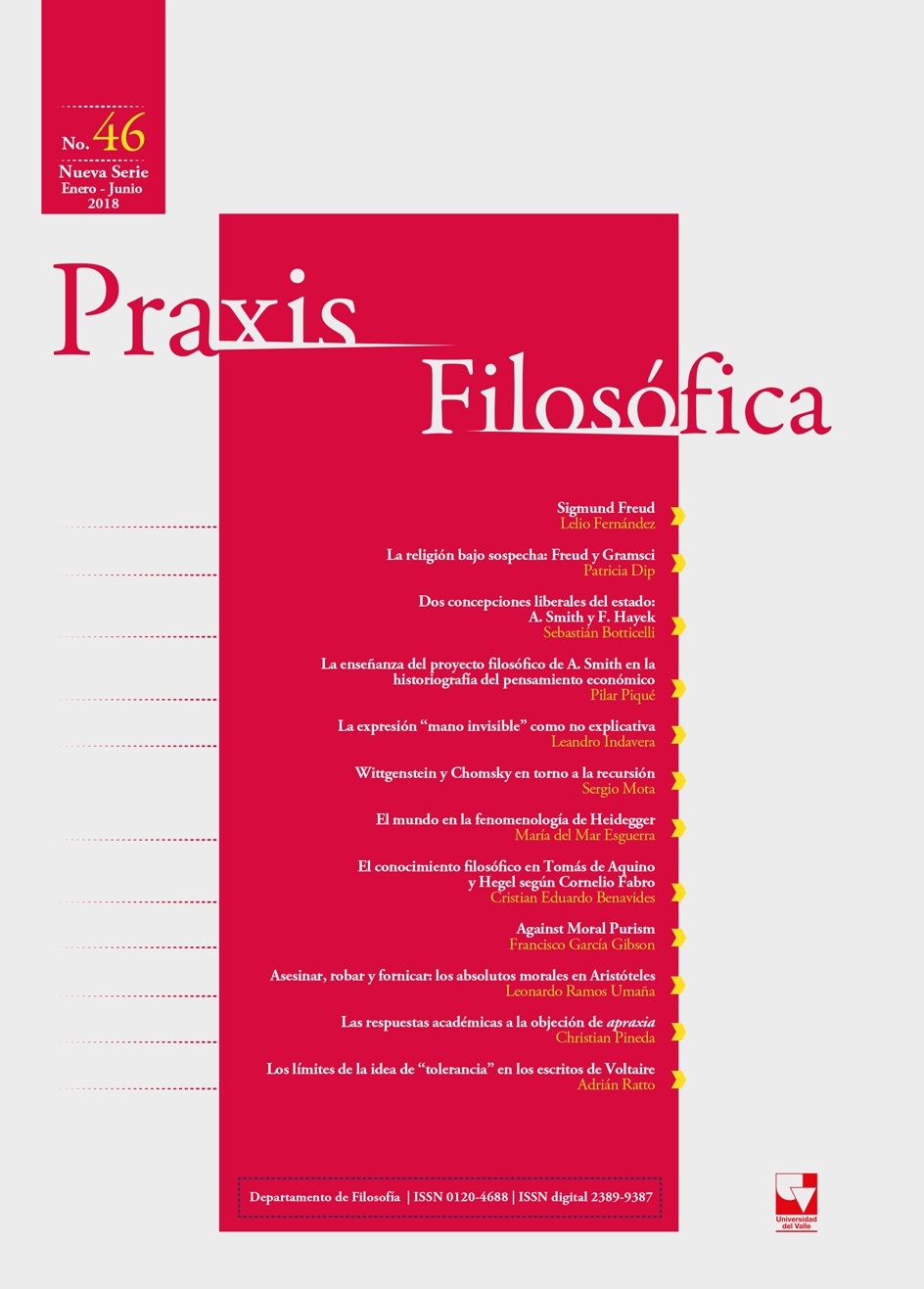
Murdering, robbing and fornicating: moral absolutes in Aristotle

Article Sidebar
Main Article Content
In book II of Nicomachean Ethics (NE), Aristotle mentions 6 cases for which the formula ‘virtue is the mid-term’ doesn’t apply, i.e., 3 actions and 3 passions where it is impossible to think about a correct mode to execute them, actions and passions that will always be wrong regardless of contexts and agents, which is what we nowadays call “moral absolutes”. Within secondary bibliography, such statement hasn’t brought forward much controversy, but very few or nothing has been observed on the fact that (1) the quality that makes those 6 (actions and passions) reprehensible is also shared by many other actions and passions and, therefore, (2) we would be forced to accept that there’s a quite large list of “moral absolutes” in Aristotle.
- Virtue
- Ethics
- Moral absolutes
- Moral objectivism
- Mid-term
Aristóteles. Ethica Nicomachea. Franz Susemihl (ed.). Teubner: Leipzig, 1887.
Aristóteles. [EE] Eudemian Ethics (edición bilingüe). H. Rackham (trad). Cambridge: Loeb Classical Library, 1935.
Aristóteles. Ética Eudemia. Carlos Megino Rodríguez (trad.). Madrid: Alianza Editorial, 2002.
Aristóteles. [MM] Magna Moralia. G. Cyril Armstrong (trad.). Cambridge: Loeb Classical Library, 1935.
Aristóteles. Nicomachean Ethics. David Ross (trad.). Oxford: Clarendon Press, 1925.
Aristóteles. Nicomachean Ethics. C.D.C. Reeve (trad). Indianapolis: Hackett Publishing Company, 2014.
Aristóteles. Nicomachean Ethics, books II-IV. C.C.W. Taylor (trad). New York: Oxford University Press, 2006.
Aristóteles. [Pol.] Política (edición bilingüe). Julián Marías & María Araujo (trad.). Madrid: Centro de Estudios Políticos y Constitucionales, 2005.
Aristóteles. [Probl.] Problemas. Ester Sánchez Millán (trad.). Madrid: Editorial Gredos, 2004.
Aristóteles. [Rhet.] Retórica (edición bilingüe). Antonio Tovar (trad.). Madrid: Centro de Estudios Políticos y Constitucionales, 1971.
Aristóteles. Retórica. Alberto Bernabé (trad.). Madrid: Alianza Editorial, 1998.
Aristóteles. Rhetoric. George A. Kennedy (trad.). New York: Oxford University Press, 2007.
Aristóteles. [Top.] Tópicos. En: Tratados de Lógica, vol. 1. Miguel Candel Sanmartín (trad.). Madrid: Editorial Gredos, 2008.
Anagnostopoulos, G. (1994) Aristotle on the Goals and Exactness of Ethics. Berkeley: University of California Press.
Aubenque, P. (1969) La prudencia en Aristóteles. María José Torres Gómez-Pallete (trad.). Barcelona: Crítica.
Carr, D. (1999) “Virtue, akrasia and moral weakness”. En: Virtue ethics and moral education. David Carr, Jan Steutel (eds.). New York: Routledge, pp. 143-156.
Chappell, T. (2006) “The Variety of Life and the Unity of Practical Wisdom”. En:Values and Virtues: Aristotelianism in Contemporary Ethics. Timothy Chappell (ed.). New York: Oxford University Press, pp. 136-157.
Finnis, J. (2011) “Moral Absolutes in Aristotle and Aquinas”. En: Collected Essays Volume 1. New York: Oxford University Press, pp. 187-198.
Hardie, W. (1964) “Aristotle’s Doctrine That Virtue Is a “Mean””. En: Proceedings of the Aristotelian Society, New Series, Vol. 65 (1964 - 1965), pp. 183-204.
Kant, I. (1797) “Sobre un presunto derecho a mentir por filantropía”. En: Teoría y Práctica. Roberto Rodríguez Aramayo (ed.), Juan Miguel Palacios (trad.). Madrid: Editorial Tecnos, 1993.
Pakaluk, M. (2006) “Aristotle’s Ethics”. En: Blackwell Companions to Philosophy: A Companion to Ancient Philosophy. Mary Louise, and Pierre Pellegrin (eds.). Malden: Blackwell Publishing, pp. 374-392.
Sherman, N. (1997) Making necessity of Virtue: Aristotle and Kant on Virtue. Cambridge: Cambridge University Press.
Urmson, J. O. (1973) “Aristotle’s Doctrine of the Mean”. En: American Philosophical Quarterly, Vol. 10, No. 3 (Jul., 1973), pp. 223-230.
Winter, M. (1997) “Aristotle, hōs epi to polu Relations, and a Demonstrative Science of Ethics”. En: Phronesis, Vol. 42, No. 2 (1997), pp. 163-189.
Zagal, H. (2017) “Eutrapelia: Tomás de Aquino y Aristóteles”. En: Revista de Filosofía, (85), pp. 79-101.
Downloads




Accepted 2018-02-05
Published 2018-01-15
De acuerdo con nuestra política (Licencia Creative Commons CC BY-NC-SA 4.0) los artículos presentados y sometidos al proceso editorial en la revista Praxis Filosófica no tienen costo alguno para sus autores ni retribuciones económicas para la revista. El artículo de carácter inédito, producto de investigación o de algún proyecto que se presente a Praxis Filosófica, no podrá estar sometido a otro proceso de publicación durante el proceso que se lleve en nuestra revista.