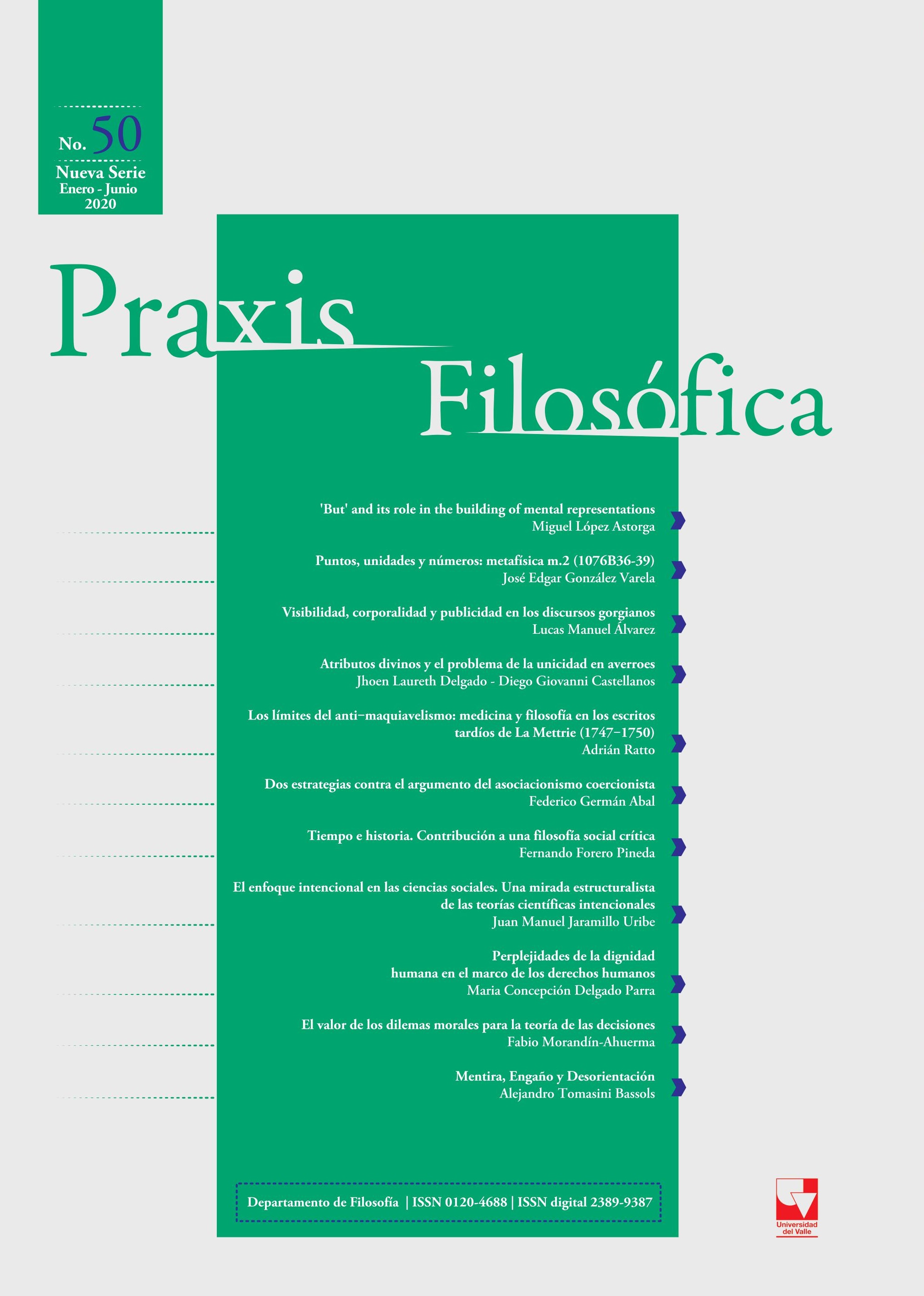
Lying, Deceiving and Misleading

Article Sidebar
Main Article Content
In this essay I deal with some of the concepts which constitutes a particular family, namely, the concepts of lying, deceiving and misleading. One of my goals is to carry out a conceptual analysis which would fit in the Wittgensteinian perspective on language. I argue that those concepts are hierarchically organized and that “deceive” is the most basic of all, since lying is something that only users of language can do and the phenomena of deceiving can be found in the animal kingdom. I try to establish certain grammatical truths like “one cannot lie without intending to deceive” or “it’s not possible to lie using only true propositions”. I suggest a light correction should be done to the traditional definition of ‘lying’ by replacing ‘believe’ by ‘know’. I also examine the notion of bald-face lie and I try to show that it’s a superfluous notion (not to say a spurious one). I critically examine the idea that lying is always an unacceptable action and I offer some examples to support my case. Finally, I briefly discuss the interesting question whether it is possible to mislead someone by means of truths and I show that although no lies are proffered it’s perfectly possible to mislead him.
- Lie
- Behaviour
- Mislead
- Language
- Truth
Tomasini, A. (2001). Teoría del Conocimiento Clásica y Epistemología Wittgensteiniana. Ciudad de México, México: Plaza y Valdés.
Downloads




De acuerdo con nuestra política (Licencia Creative Commons CC BY-NC-SA 4.0) los artículos presentados y sometidos al proceso editorial en la revista Praxis Filosófica no tienen costo alguno para sus autores ni retribuciones económicas para la revista. El artículo de carácter inédito, producto de investigación o de algún proyecto que se presente a Praxis Filosófica, no podrá estar sometido a otro proceso de publicación durante el proceso que se lleve en nuestra revista.